
 By Editor
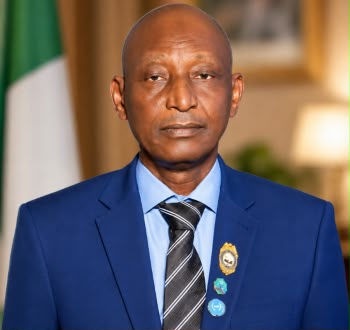
 The National Secretary of Project 774 Network, retired Deputy Inspector-General of Police (DIG) Mohammed Usaini Gumel, has said that Nigeria’s battle against terrorism, banditry and kidnapping can only be won through stronger collaboration between citizens and security agencies at the grassroots.
Gumel made the remarks ahead of the National Citizens’ Stakeholders’ Engagement on Countering Terrorism and Insecurity, scheduled for Friday, July 31, 2026, at the Ladi Kwali Hall, Abuja Continental Hotel, Abuja.
The summit, themed “Our Security, Our Duty: Citizens Standing With Our Troops To End Terrorism, Banditry And Kidnapping,” is expected to bring together top government officials, security experts, traditional rulers, religious leaders, lawmakers, civil society groups, academia, the private sector, youth and women organisations to chart practical solutions to Nigeria’s security challenges.
Among the dignitaries expected at the event are the National Security Adviser, Mallam Nuhu Ribadu, who will serve as Special Guest of Honour and Conversational Lead; Professor Sunday Bontur Lugard of the University of Jos as keynote speaker; the Emir of Kano, Muhammadu Sanusi II, as Chief Convener; the Sultan of Sokoto, Alhaji Muhammadu Sa’ad Abubakar III; the Ooni of Ife, Oba Adeyeye Enitan Ogunwusi; the Obi of Onitsha, Igwe Alfred Nnaemeka Achebe; and the President of the Christian Association of Nigeria (CAN), Most Rev. Daniel Okoh.
Speaking on the rationale behind the summit, Gumel said insecurity remains one of Nigeria’s greatest national challenges despite the sacrifices and successes recorded by the Armed Forces, the Nigeria Police Force, intelligence agencies and other security institutions.
According to him, the time has come to broaden the responsibility for national security by actively involving citizens, communities, traditional institutions, civil society organisations, development partners and the private sector.
“Security is everyone’s responsibility,” he said.
Security Must Begin at the Local Government Level
Gumel argued that lasting security cannot be achieved through policies formulated in Abuja alone, stressing that criminal activities are rooted within local communities.
He explained that terrorists, bandits and kidnappers recruit members, establish hideouts and carry out operations across towns, villages, forests and border communities in Nigeria’s 774 Local Government Areas.
“If we truly want sustainable security, every Local Government Area must become an active security ecosystem where citizens, security agencies, traditional rulers, religious leaders, women, youth and community organisations work together to identify threats early and prevent crime before it escalates,” he said.
Community Intelligence Critical
The former DIG noted that while Nigeria’s security architecture remains vital, evolving security threats require stronger community participation and intelligence gathering.
He advocated the development of comprehensive security profiles for every Local Government Area to identify peculiar threats, criminal routes, illegal arms networks and other emerging risks.
He also called for the establishment of functional Local Government Security Councils involving security agencies, traditional rulers, religious leaders, youth and women groups, farmers, herders and transport unions.
According to him, police divisions across the country should be strengthened with adequate personnel, logistics, communication equipment and operational resources to improve emergency response.
Decentralised Policing
Gumel reiterated his support for decentralised policing, saying Nigeria’s size and security realities require policing that is both nationally coordinated and locally responsive.
He said a constitutionally regulated system where federal and state policing institutions operate under clear safeguards would improve operational effectiveness while ensuring accountability, professionalism and respect for human rights.
Security and Development Must Go Together
Beyond law enforcement, Gumel stressed that insecurity is closely linked to unemployment, poverty, drug abuse, poor education and inadequate public services.
He said addressing these socio-economic challenges alongside effective policing would significantly reduce criminality and strengthen national security.
Summit to Produce Action Plan
He disclosed that participants at the summit would develop practical recommendations aimed at strengthening collaboration among government, security agencies, lawmakers, traditional and religious institutions, civil society and citizens.
According to him, the engagement will produce an Abuja Citizens’ Declaration and a comprehensive conference communiqué containing actionable recommendations for improving national security through stronger citizen participation and institutional cooperation.
Shared Responsibility
Gumel said Project 774 Network is founded on the philosophy of Shared National Responsibility, which promotes the idea that nation-building is not the exclusive duty of government but a collective responsibility involving every Nigerian.
He described the organisation as a non-partisan civic movement committed to supporting Nigerian troops, strengthening national unity and promoting peace, responsible citizenship and sustainable development across all 774 Local Government Areas.
“Our message is simple,” Gumel said.
“If we secure our communities, we secure our Local Government Areas. If we secure all 774 Local Government Areas, we secure Nigeria. The road to a safer Nigeria begins in every ward, every village, every town and every community.”
 Kano Anti-Drug Committee Warns Politicians, Others Against Seeking Release of Suspects
  Nigeria, Benin, Cameroon Customs Move to Modernise Borders, Boost AfCFTA Trade
  Nigeria Customs Releases Final List for ASC II Recruitment, Sets July 29 Deadline for Medical Certificate Upload
  Jigawa First Lady Joins Kebbi Counterpart for Mass Wedding of 300 Orphans, Vulnerable Couples
  Kano Government Arrests Three Over Alleged Illegal Demolition of 50-Year-Old Watari Bridge
  Customs Moves to Shield Local Industry, Auctions ₦26.53m Seized Goods