
 By Editor
 By Ladan Nasidi Garko,Kano
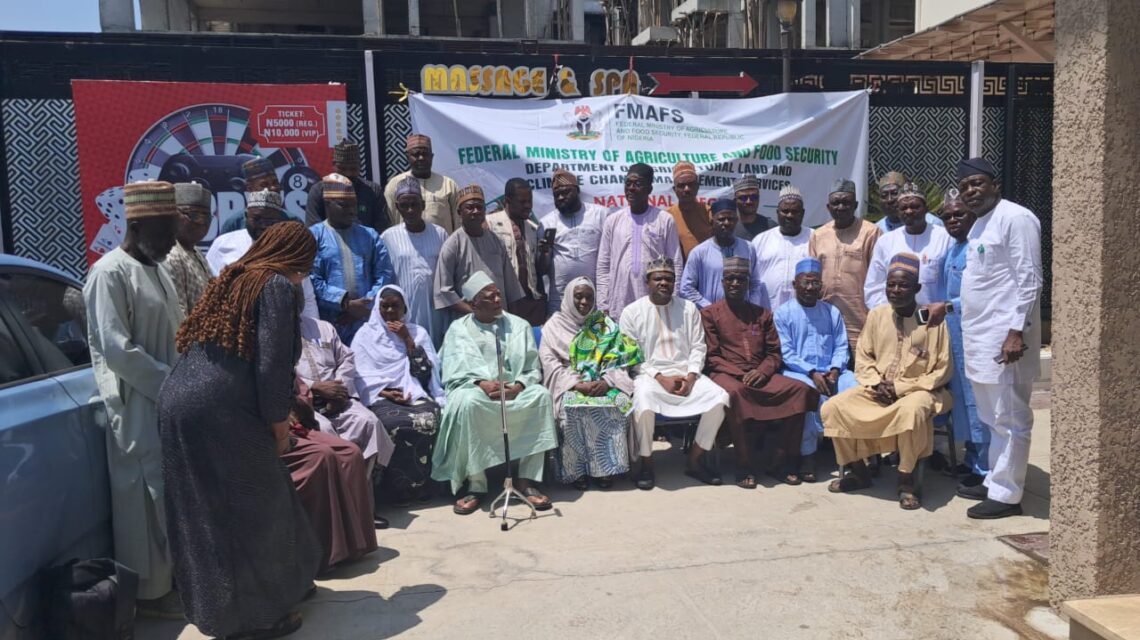
The Federal Ministry of Agriculture and Food Security has commenced consultations with stakeholders in the North-West as part of efforts to review and develop the Nigeria Agricultural Land and Soil Management Policy (NALSMP) 2027–2035.
The two-day zonal workshop, held in Kano on Wednesday, is aimed at gathering views from farmers, researchers, government officials, development partners and other stakeholders to develop a sustainable framework for managing the country’s agricultural land and soil resources.
Speaking at the workshop, the Director of Agricultural Land and Climate Change Management Services in the ministry, Mr Olanipẹkun Oshadiya, said the policy review was critical to achieving food security and strengthening Nigeria’s agricultural sector.
Oshadiya, who was represented by his Personal Assistant on Gender and Innovation, Dr Wasiu Oyediran, described agricultural land and soil as the foundation of Nigeria’s food system.
He said their productivity and sustainability were essential to increasing food production, improving livelihoods, protecting the environment and promoting national development.
“If soil quality deteriorates, agriculture will inevitably suffer. A decline in agriculture means a lack of food for our citizens, insufficient raw materials for industries and a deficit in commodities for foreign exchange,” Oshadiya said.
“We cannot afford to maintain the current situation and continue relying on food imports for a population of 230 million.”
According to him, Nigeria’s agricultural resources are under growing pressure from soil degradation, erosion, nutrient depletion, deforestation, climate change, population growth, urban expansion and competing land-use demands.
He said the effects were already evident in declining soil fertility and agricultural productivity, increased vulnerability of farmers to climate-related shocks, loss of soil organic matter, erosion and desertification.
Oshadiya explained that the policy review was not simply an exercise in updating an existing document but an opportunity to develop an inclusive, science-based and practical framework capable of responding to both current and emerging challenges.
He urged stakeholders to prioritise sustainable soil management, climate-smart agriculture, land degradation and restoration, land governance, land-use planning, soil information systems, research and innovation, as well as financing and investment.
He said the revised policy should encourage agricultural practices that restore soil fertility, improve soil organic matter and strengthen farmers’ resilience to drought, floods, extreme temperatures and other climate-related risks.
Government, States and Stakeholders Must Work Together
Oshadiya also called for stronger collaboration among the Federal, State and Local Governments, traditional institutions, local communities, research organisations, development partners and the private sector.
He stressed that reliable data on soil characteristics, land capability, degradation and suitability would be essential for evidence-based agricultural planning and decision-making.
The director disclosed that the ministry, in collaboration with development partners, had made significant progress over the past two years, including the development of the Nigerian Soil Information System (NiSS).
According to him, the system is expected to provide soil data and digital advisory services at the Local Government Area level, enabling farmers to obtain information on soil pH, organic matter and appropriate fertiliser recommendations for their farms.
He added that the ministry was also integrating the National Fertilizer and Soil Health Strategy (NFSHS) into the ECOWAS Regional Fertilizer Hub.
Other initiatives, he said, included a partnership with the Bill and Melinda Gates Foundation under the GP Soil Matters initiative in Nigeria and the provision of modern laboratory equipment across 12 states.
Oshadiya said the ministry also planned to revitalise soil-testing laboratories across the 36 states and the Federal Capital Territory, while retraining Agricultural Development Programme agents in soil-health diagnostics.
He assured stakeholders that the revised policy would be farmer-centred, affordable, locally appropriate, gender-responsive and accessible to smallholder farmers, while also supporting commercial agriculture.
Implementation Key to Success
On implementation, Oshadiya said producing a policy document alone would not guarantee success.
He stressed the need for clear implementation frameworks, measurable targets, defined institutional responsibilities, sustainable funding mechanisms, monitoring and evaluation systems, and accountability measures.
Also speaking, Mr Joshua Arogunyo, Country Director of the Soil Values Programme, said the initiative was committed to working with Nigerian institutions to ensure that soil management became an integral component of agricultural development and food security.
Similarly, Prof. Sanusi Mohammed Gaya, Director of the Centre for Dryland Agriculture at Bayero University, Kano, described the workshop as timely, particularly in view of climate change and increasing pressure on agricultural resources.
Mohammed-Gaya, represented by Dr Mustafa Bello, said effective soil management was crucial to sustainable agricultural development and urged stakeholders to ensure that the outcomes of the consultation translated into practical interventions.
Representing the North-West states, Alhaji Faruk Sarki, Permanent Secretary, Kebbi State Ministry of Agriculture, commended the Federal Government for initiating the policy review.
He said agriculture remained central to the economies of states in the region and called for policies capable of strengthening agricultural resilience and promoting sustainable land management.
The President of the Soil Science Society of Nigeria, Prof. Jibrin Mohammed Jibrin, also emphasised the importance of sound soil management to sustainable food production.
Meanwhile, the Lead Consultant for the NALSMP, Prof. James Jayeoba, presented a paper titled “Overview of the NALSMP Development Process, Objectives and Expected Outputs.”
He also led discussions on “Agro-Ecological, Land and Soil Zones: Priorities and Local Realities.”
Participants at the workshop included representatives of the agriculture ministries in Kaduna, Kano, Katsina, Jigawa, Zamfara, Kebbi and Sokoto states, as well as farmers’ organisations, the All Farmers Association of Nigeria (AFAN), Sasakawa Africa Association, small-scale farmers and other stakeholders.
The consultation is expected to contribute to the development of a comprehensive NALSMP framework designed to promote sustainable land and soil management, improve agricultural productivity and strengthen Nigeria’s long-term food security.
 Hausa Day: Governor Yusuf Says Language, Culture Are Pillars of African Unity
  Kano Gov Yusuf Urges Muslims to Embrace Prophet Muhammad’s Virtues
  Kano Pilgrims Board to Introduce LGA-Level Medical Screening for 2027 Hajj
  David Mark Urges Nigerians to Embrace Peace, Unity at Eid-ul-Maulud
  Garba Urges Kano Journalists to Highlight Development Under Governor Yusuf
  Amina Namadi Empowers Vulnerable Women in Garki with Livelihood Equipment