
 By Editor
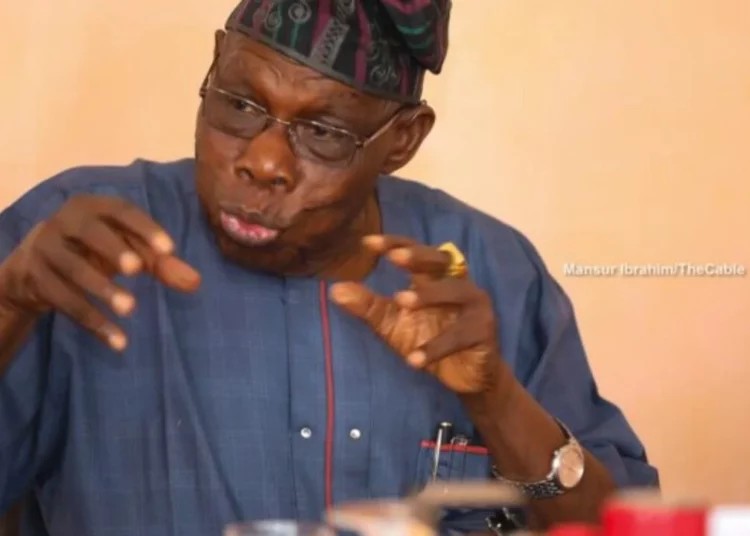
 Former President Olusegun Obasanjo has questioned the growing role of the judiciary in determining election outcomes across Africa, warning that court decisions that overturn the choices of millions of voters could weaken democratic legitimacy.
Obasanjo spoke as chairman of the 2026 Goodluck Jonathan Foundation (GJF) Democracy Dialogue, held at the Ahmadu Bello International Conference Centre in Bauchi.
The dialogue, themed “Beyond Elections: Can Political Parties and Judiciary Save African Democracy?”, brought together former leaders, political figures, academics and civil society representatives from across Africa to examine the continent’s democratic challenges.
Speaking at the event, Obasanjo questioned whether it is consistent with democratic principles for a small number of judges to overturn the outcome of an election decided by millions of citizens.
“If millions of people have voted and five people would form a decision either in favour or against the decision of millions of people, is that democracy?”
He also raised concerns about the independence of the judiciary, questioning whether courts across Africa are sufficiently insulated from political and governmental influence.
According to the former president, democracy should not be measured only by elections or court battles. He argued that democratic governance must translate into tangible improvements in citizens’ lives, including security, equality, social welfare and an end to marginalisation.
Obasanjo also challenged African political parties to demonstrate their capacity to strengthen democracy.
“Can the political parties deliver, or are they delivering? These are the questions the dialogue needs to answer.”
Jonathan seeks review of Africa’s democratic model
Former President Goodluck Jonathan, who also addressed the gathering, called for a fundamental review of Africa’s democratic systems to make them more responsive to the continent’s historical and cultural realities.
In his vote of thanks, Jonathan advocated structural reforms aimed at preventing excessive concentration of political power in the hands of a single individual.
He cited Switzerland’s collective executive model as a possible option for some African countries, arguing that a system without an all-powerful president could help reduce arbitrary decision-making.
“At the top level of the presidency, perhaps the Swiss model, where you don’t have one powerful president, may be the best for some African countries.”
Jonathan recalled that he had previously warned about the dangers of concentrating too much power in one person.
He also cautioned against judging the strength of African democracy solely by the conduct of periodic elections.
Citing findings from the 2024 Afrobarometer survey covering 39 African countries, Jonathan said more than 70 per cent of Africans expressed a preference for democracy, even as satisfaction with the way democracy is being practised remains low.
“This clearly shows that there is something fundamentally wrong with our democracy.”
The former president said genuine democracy requires an open civic space, protection of human rights, press freedom and independent institutions.
He stressed that the judiciary and legislature must be strong enough to hold the executive accountable, while citizens must be free to express their views without intimidation.
“If citizens are gagged, if the civic space is choked by the executive, then, of course, there is no democracy.”
The discussions at the GJF Democracy Dialogue highlighted growing concerns over the state of democracy in Africa and the need for reforms that go beyond elections to address institutional independence, political accountability and citizens’ welfare.
 Sokoto ADC Chieftain, Murtala Madugu, Defects to APC
  Whitecrust Targets 200,000 Kano Residents in Financial Inclusion Drive
  Customs Seize Expired Noodles, Rice, Cannabis, Explosives Worth ₦365m at Seme Border
  JIBWIS Leader Jingir Reaffirms Support for Muslim-Muslim Ticket, Says Position Predates Tinubu
  Shagari Applauds Aliyu’s Performance, Urges Sokoto Residents to Support Development Drive
  NRO Backs Catholic Bishops, Urges Tinubu Government to Act on Nigeria’s Worsening Crisis