

 By Editor
 The Nigerian Government has called on state governments and local communities to take full ownership of the LUMINAH 2030 initiative, which is designed to empower one million underserved girls across the country.
Minister of State for Education, Prof. Suwaiba Ahmad, stated this on Monday in Abuja at a two-day Stakeholder Engagement with LUMINAH 2030 pilot states.
She said taking the ownership has become as the success of the policy will not be measured in Abuja the nation’s capital but in states and local communities.
The LUMINAH 2030 Initiative is a Nigerian programme launched in March 2025 by the Federal Ministry of Education to economically and educationally empower over one million underserved girls and women by 2030. Key components include providing vocational and STEM education, financial support, leadership training, and establishing safe learning centres.
Ahmad raised concern over persistent gaps in inclusion, learning quality, and gender equity in Nigeria’s education system despite recorded progress in some areas.
“Let every state become a LUMINAH exemplary state. Let every community become a place where girls can learn safely and with dignity,” she said.
After screening a Video on the plight of the underserved, the Minister said “the
engagement is a moment of reflection, renewal, and recommitment to the future of every Nigerian girl.”
“We all saw that emotional video, those girls are our daughters. Girls who wake before dawn to fetch water instead of going to school; girls who walk miles to unsafe classrooms or hawk on the streets when they should be learning. Their cries for learning are not just calls for help; they are calls for justice, dignity, and opportunity,” she explained.
The Minister said “the Tinubu administration’s Renewed Hope Agenda had birthed NESRI, which rests on six priorities, namely: expanding technical and vocational education and training, TVET, strengthening STEMM and innovation, reducing out-of-school children, empowering the girl child, ensuring quality and equitable education, and building robust data and digital systems.’
While acknowledging progress made through programmes such as the Adolescent Girls’ Initiative for Learning and Empowerment, AGILE, she noted that “too many girls remain out of school, still facing barriers rooted in poverty, insecurity, and harmful traditions.”
“LUMINAH 2030 goes beyond schooling. It tackles the root causes of exclusion by empowering mothers and caregivers to earn and support their children’s education. It is about reshaping mindsets, driving social reorientation, and building intergenerational change,” she said.
Also speaking, the Executive Secretary of the Universal Basic Education Commission, UBEC, Hajia Aisha Garba, said LUMINAH 2030 had been fully integrated into the Commission’s operations and those of the State Universal Basic Education Boards, SUBEBs.
Garba assured Nigerians that the initiative was “not just another programme” but “a national movement to empower over one million underserved Nigerian girls and women with education, vocational skills, and digital literacy by 2030.”
“We have institutionalised this programme by establishing a special unit on Alternative Education for Girls. A dedicated budget line has been created within the UBE matching grant for states to implement key interventions, including alternative high schools for girls, scholarships, accelerated basic education, and empowerment of mothers,” she stated.
Garba said the integration marked a major milestone in Nigeria’s commitment to Sustainable Development Goal 4, SDG 4, on inclusive and equitable quality education, noting that LUMINAH would initially operate across 12 pilot states, one from each geopolitical zone, before scaling nationally.
She revealed that UBEC had issued clear criteria for selecting beneficiary communities, focusing on areas with high numbers of out-of-school girls, deep poverty levels, and economic vulnerability.
“Our collaboration with SUBEBs is key to sustainability. We are prioritising transparency and accountability in the disbursement of funds and deployment of resources,” she stressed.
Garba assured that UBEC, in partnership with the Federal Ministry of Education and development partners, would “build a legacy of inclusion, empowerment, and opportunity for every Nigerian girl.”
 FGCKOSA Drags FG, Education Ministry, Others to Court Over Alleged FGC Kano Land-Swap Deal
  Kano Education Commissioner Visits UNESCO Headquarters in Paris to Strengthen Global Education Partnership
  CITAD Boosts Nomadic Education in Bauchi, Recruits Teachers for Neglected School
  Kano Govt Reaffirms Commitment to Education, Secures N23bn for 49 New Schools
  Kano Bags NECO Excellence Award for Massive SSCE Sponsorship Drive
 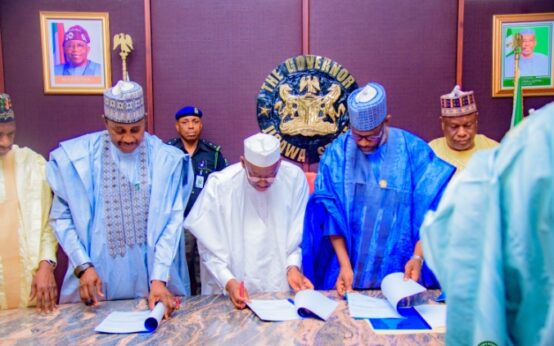 Namadi Signs Landmark Laws to Drive Grassroots Development, Boost Medical Education in Jigawa